Digital Transformation vs Business Development: Understanding the Difference
Businesses today must continuously adapt to changing customer expectations, new technologies, and growing market competition. To remain competitive, companies need to improve how they operate while finding new opportunities for growth. Two important strategies that support these goals are digital transformation and business development.
Although these concepts are closely connected, they serve different purposes. Digital transformation focuses on using technology to improve business processes, customer experiences, and operational efficiency. Business development focuses on identifying growth opportunities, building strategic relationships, expanding markets, and increasing revenue potential.
For businesses looking to grow sustainably, understanding the difference between these two approaches is essential. Whether you are a startup, a small business, or an established enterprise, working with the right Indian technology company or business development partner can help you make informed decisions about your future.
In this guide, we explore digital transformation vs business development, their key differences, their benefits, and how businesses can combine both strategies for long-term success.
What Is Digital Transformation?
Digital transformation is the process of integrating digital technologies into different areas of a business to improve operations, decision-making, customer experiences, and overall performance.
It involves more than simply adopting new software or upgrading computer systems. Successful digital transformation often requires changes in business processes, employee workflows, company culture, and the way an organisation delivers value to customers.
An experienced Indian technology company can help businesses identify technology gaps, implement suitable digital solutions, and build systems that support future growth.
Examples of Digital Transformation
Digital transformation can take several forms depending on a company’s size, industry, and business objectives.
- Business process automation: Automating repetitive tasks such as invoicing, reporting, data entry, and customer follow-ups.
- Cloud-based systems: Using cloud platforms to improve accessibility, collaboration, and scalability.
- Customer relationship management (CRM): Managing customer information, sales activities, and communication more effectively.
- Data analytics: Using business data to identify patterns, measure performance, and support better decisions.
- Website and digital platform development: Creating user-friendly websites, applications, and digital services.
- AI-powered solutions: Applying artificial intelligence where appropriate to support customer service, analysis, and operational workflows.
The objective is to make a business more efficient, adaptable, and capable of responding to changing market conditions.
What Is Business Development?
Business development is the process of identifying and creating opportunities that help a company grow. It focuses on building relationships, exploring new markets, developing partnerships, strengthening customer acquisition strategies, and increasing long-term business value.
Business development is not limited to sales. While sales teams concentrate on converting potential customers into paying clients, business development often works on creating the opportunities, relationships, and strategic foundations that support future sales.
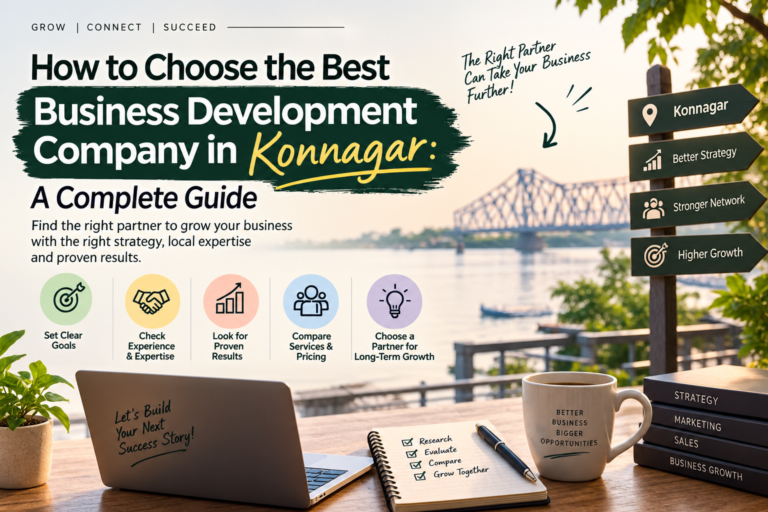
Companies searching for the best business development company in Konnagar should look for a partner that understands their business objectives, target audience, market conditions, and long-term growth plans.
Examples of Business Development
Common business development activities include:
- Market research: Identifying customer needs, industry trends, and potential opportunities.
- Strategic partnerships: Building relationships with complementary businesses and service providers.
- Lead generation: Finding potential customers who may benefit from a company’s products or services.
- Market expansion: Exploring new geographic regions, customer segments, or industry sectors.
- Client relationship management: Building trust and encouraging long-term business relationships.
- Growth strategy development: Creating plans to improve market reach, strengthen positioning, and increase revenue opportunities.
The primary objective of business development is to create sustainable growth by connecting a company’s capabilities with the right market opportunities.
Digital Transformation vs Business Development: Key Differences
Although both strategies contribute to business growth, their primary focus and methods are different.
| Comparison factor | Digital transformation | Business development |
|---|---|---|
| Primary focus | Improving business operations through technology | Creating opportunities for business growth |
| Main objective | Efficiency, scalability, and better digital experiences | Market expansion, partnerships, and revenue opportunities |
| Typical activities | Automation, software implementation, data analytics, digital platforms | Market research, networking, partnerships, lead generation |
| Key resources | Technology, software, data, and digital expertise | Market knowledge, relationships, strategy, and communication |
| Measures of success | Reduced manual work, improved productivity, system adoption | Qualified opportunities, new partnerships, customer acquisition, revenue growth |
| Time horizon | Short-term improvements and long-term modernisation | Short-term opportunities and long-term market development |
The most important distinction is that digital transformation improves how a business works, while business development focuses on where and how a business can grow.
However, these two functions are not competitors. When aligned with a shared business strategy, they can reinforce each other.
Why Digital Transformation Matters for Modern Businesses
Technology has changed how businesses communicate, serve customers, manage information, and compete in the marketplace. Companies that rely entirely on outdated systems or manual processes may find it difficult to scale efficiently.
Digital transformation helps address these challenges.
1. Improves Operational Efficiency
Manual processes can consume valuable time and increase the risk of human error. Automation and integrated software systems can simplify repetitive activities, improve consistency, and allow employees to focus on more valuable work.
2. Supports Better Decision-Making
Digital tools can help businesses collect and analyse information about sales, customer behaviour, operational costs, and performance. When this information is reliable and accessible, managers can make more informed decisions.
3. Enhances Customer Experience
Customers increasingly expect convenient communication, quick responses, and smooth digital experiences. A well-designed website, efficient customer support system, and organised customer database can help businesses meet these expectations.
4. Makes Growth More Scalable
As a business expands, its operational complexity usually increases. Appropriate digital systems can help manage larger volumes of transactions, customer information, and internal workflows without relying entirely on additional manual effort.
5. Strengthens Business Competitiveness
Digital transformation can help businesses respond to market changes, improve service delivery, and adopt suitable new capabilities. The right technology investment can become an important part of a company’s competitive strategy.
Why Business Development Is Essential for Sustainable Growth
Even an efficient business needs customers, market opportunities, and a clear growth strategy. Business development helps connect a company’s products or services with the right audience.
1. Identifies New Market Opportunities
Market research helps businesses understand changing customer needs, emerging trends, and underserved market segments. This information can reveal opportunities that might otherwise remain unnoticed.
2. Builds Strategic Partnerships
Partnerships can create access to new audiences, complementary expertise, distribution channels, and shared resources. Strong relationships can help businesses expand their reach without having to build every capability independently.
3. Creates a More Consistent Pipeline of Opportunities
A structured business development process helps companies identify potential clients, qualify opportunities, and maintain relationships over time. This can support more predictable growth when combined with an effective sales process.
4. Improves Market Positioning
Understanding competitors and customer expectations helps a business communicate its value more clearly. Strong positioning makes it easier for potential customers to understand why they should consider a particular product or service.
5. Supports Long-Term Revenue Growth
Business development focuses on building opportunities that may generate value over time. Strategic partnerships, repeat business, new customer segments, and stronger client relationships can all contribute to sustainable growth.
Can Digital Transformation and Business Development Work Together?
Yes. In many businesses, combining digital transformation with business development can produce better results than treating them as separate priorities.
Consider a company that wants to expand into new markets. Its business development team identifies a promising customer segment and develops a partnership strategy. However, the company struggles to manage incoming leads, respond to enquiries, and track customer interactions.
Digital transformation can help address these operational challenges through a CRM system, automated lead routing, improved reporting, and a more effective website.
The result is a stronger connection between market opportunities and the company’s ability to convert them into business outcomes.
Here are a few practical ways the two strategies can work together:
- CRM implementation: Supports lead management, client communication, and relationship development.
- Marketing automation: Helps organise campaigns and follow-ups while reducing repetitive work.
- Business intelligence: Provides insights that support market selection and growth planning.
- Digital platforms: Help businesses reach customers across locations and deliver services more conveniently.
- Integrated reporting: Connects operational performance with sales and business growth indicators.
An Indian technology company with a clear understanding of business objectives can help organisations evaluate suitable technology solutions. Meanwhile, business development expertise can help ensure that these investments support meaningful market opportunities rather than technology adoption for its own sake.
Which Strategy Should Your Business Prioritise?
The right starting point depends on your current challenges, available resources, and growth objectives.
Choose Digital Transformation When:
- Your team spends too much time on repetitive manual work.
- Customer information is scattered across different systems.
- Reporting and decision-making are slow or inconsistent.
- Your website or digital platforms no longer meet customer expectations.
- Existing processes make it difficult to scale operations.
- Your business needs better data management, automation, or software integration.
Prioritise Business Development When:
- You need to reach new customers or markets.
- Your company lacks a consistent process for identifying opportunities.
- You want to establish strategic partnerships.
- Your business needs stronger market positioning.
- You want to explore new services, customer segments, or revenue channels.
- Your current operations are capable of supporting additional demand, but growth opportunities are limited.
When Should You Invest in Both?
Consider a combined approach when your business has clear growth ambitions but also faces operational limitations.
For example, a company may generate more leads through partnerships and marketing, but struggle to manage the increased demand. In this situation, business development creates opportunities, while digital transformation helps the company handle those opportunities efficiently.
Rather than asking which strategy is universally better, business owners should identify the biggest barrier to growth and prioritise accordingly.
How to Choose the Right Technology or Business Development Partner
External expertise can help businesses avoid unnecessary investments and create more structured growth plans. However, the right partner should be selected according to the problem you want to solve.
1. Define Your Business Objectives
Start by identifying specific outcomes. Do you want to automate workflows, improve customer management, launch a digital platform, enter a new market, or build strategic partnerships?
Clear objectives make it easier to evaluate potential partners.
2. Evaluate Relevant Experience
Look for a partner with relevant experience in your industry or the type of challenge you face. Ask how their proposed approach would address your needs and what measurable outcomes they would track.
3. Assess Their Strategic Approach
A reliable partner should understand your business before recommending solutions. Be cautious of proposals that focus on technology or growth tactics without considering your goals, budget, existing processes, and target audience.
4. Look for Clear Communication
The partner should explain its process, responsibilities, expected deliverables, timelines, and potential limitations. Clear communication helps prevent misunderstandings throughout the engagement.
5. Consider Long-Term Scalability
The right solution should support your current needs while leaving room for future development. For technology projects, consider integration, security, maintenance, and scalability. For business development, consider relationship quality, repeatable processes, and the long-term value of opportunities.
Businesses looking for an Indian technology company should evaluate both technical capability and an understanding of business requirements. Similarly, companies searching for the best business development company in Konnagar should assess strategic thinking, market understanding, communication, and the suitability of the proposed growth plan.
The best partner is not necessarily the one offering the most services. It is the one whose expertise aligns with your specific business objectives.
Common Mistakes Businesses Should Avoid
Digital transformation and business development can deliver significant value, but poorly planned initiatives may waste resources.
Adopting Technology Without a Clear Purpose
Buying software simply because it is popular does not guarantee business improvement. Identify the problem first, then choose technology that addresses it.
Focusing on Growth Without Operational Readiness
Generating more enquiries is not always beneficial if a company cannot respond quickly, deliver consistently, or manage customer relationships effectively.
Treating Business Development as Sales Alone
Business development includes strategic partnerships, market research, opportunity identification, and relationship building. Reducing it to immediate sales targets may limit long-term growth.
Ignoring Employee Adoption
New technology works best when employees understand how to use it and why it matters. Training, communication, and workflow planning should be included in digital transformation initiatives.
Measuring Success Without Clear Metrics
Every initiative should have appropriate performance indicators. Technology projects may track process efficiency, error rates, adoption, and customer experience. Business development may track qualified leads, partnership outcomes, conversion rates, and revenue contribution.
Expecting Immediate Results
Both digital transformation and business development often require planning, implementation, testing, and ongoing improvement. Set realistic expectations and review progress regularly.
A Practical Roadmap for Business Growth
Businesses do not need to transform every process or pursue every market opportunity at once. A phased approach can make progress more manageable.
Step 1: Assess your current position. Review existing workflows, customer acquisition channels, technology systems, and operational challenges.
Step 2: Identify your biggest growth barrier. Determine whether the primary issue is operational inefficiency, limited market reach, weak customer management, or a combination of factors.
Step 3: Set measurable goals. Establish specific objectives and baseline performance measures before investing resources.
Step 4: Prioritise the right initiatives. Select a manageable technology improvement, business development activity, or coordinated set of projects.
Step 5: Implement and monitor. Assign responsibilities, provide employee training where needed, and track relevant performance indicators.
Step 6: Review and improve. Use the results to refine your processes, improve customer experiences, and identify the next opportunity for growth.
This approach helps businesses make decisions based on their actual needs rather than following trends without a clear strategy.
Conclusion: Building a Stronger Business Through Technology and Growth Strategy
Digital transformation and business development serve different purposes, but both can play an important role in long-term business success.
Digital transformation helps companies improve processes, adopt suitable technology, and create more efficient ways of working. Business development helps them identify opportunities, strengthen relationships, enter new markets, and build a foundation for sustainable growth.
The most effective strategy depends on your business priorities. If operational inefficiency is limiting performance, digital transformation may be the right starting point. If your business needs new markets, stronger partnerships, or a more consistent pipeline of opportunities, business development may deserve greater attention.
For many organisations, the greatest value comes from aligning both strategies. Technology can help a business operate more effectively, while business development ensures that its capabilities are directed towards relevant market opportunities.
Whether you are evaluating an Indian technology company for digital improvements or researching the best business development company in Konnagar to support your growth plans, begin with a clear understanding of your objectives. Choose solutions that address real challenges, measure the outcomes, and build on what works.
Sustainable growth is not simply about adopting more technology or pursuing more opportunities. It is about connecting the right capabilities with the right strategy.
Frequently Asked Questions (FAQs)
1. What is the main difference between digital transformation and business development?
Digital transformation uses technology to improve business processes, systems, and customer experiences. Business development focuses on identifying growth opportunities, building partnerships, expanding markets, and supporting revenue growth.
2. Is digital transformation part of business development?
Not necessarily. They are separate business functions, but digital transformation can support business development by improving lead management, customer data, reporting, and operational efficiency.
3. Which is more important for a small business: digital transformation or business development?
It depends on the business’s biggest challenge. A company struggling with manual processes may benefit from digital improvements, while a company with efficient operations but limited market reach may need to prioritise business development.
4. How can technology support business development?
Technology can support customer relationship management, lead tracking, market analysis, marketing automation, performance reporting, and communication. These tools can make business development activities more organised and measurable.
5. What services might an Indian technology company provide?
Depending on its capabilities, an Indian technology company may provide software development, website development, system integration, automation, cloud solutions, data analytics, or technology consulting. Businesses should confirm a provider’s actual services before engaging it.
6. How do I choose the best business development company in Konnagar?
Evaluate the company’s understanding of your market, strategic approach, relevant experience, communication, proposed deliverables, and measurement process. Choose a partner whose approach fits your business goals and budget.
7. Can digital transformation reduce business costs?
It can help reduce certain costs by improving efficiency, automating repetitive work, and reducing errors. However, the results depend on implementation quality, adoption, ongoing expenses, and the processes being improved.
8. How long does digital transformation take?
The timeline depends on the project’s scope. A focused automation or software implementation project may take considerably less time than a company-wide transformation involving multiple systems, teams, and processes.
9. How can business development contribute to long-term growth?
Business development can help identify new markets, build strategic partnerships, improve customer acquisition opportunities, and establish stronger client relationships. Results depend on market conditions, execution, and the company’s ability to deliver value.
10. Can a business implement both strategies at the same time?
Yes. A business can pursue market opportunities while improving the systems needed to manage them. A coordinated plan helps ensure that growth initiatives and technology investments support the same objectives.