Top Technology Challenges Faced by Indian Businesses and How to Solve Them
Technology has become an essential part of business growth in India. From small businesses and startups to established enterprises, organisations are using digital tools to improve productivity, reach customers, manage operations, and stay competitive. However, adopting technology also brings challenges, including cybersecurity risks, rising costs, outdated systems, skill shortages, and difficulties integrating new solutions.
For many companies, the challenge is not simply choosing the latest technology. It is finding the right solutions that support long-term business goals.
An experienced Indian technology company can help businesses identify these challenges, implement suitable digital solutions, and build a more efficient operating model. Similarly, working with a reliable business development partner can help organisations align technology investments with customer acquisition, operational efficiency, and sustainable growth.
In this blog, we explore the top technology challenges faced by Indian businesses and practical ways to overcome them.
Why Is Technology Important for Indian Businesses?
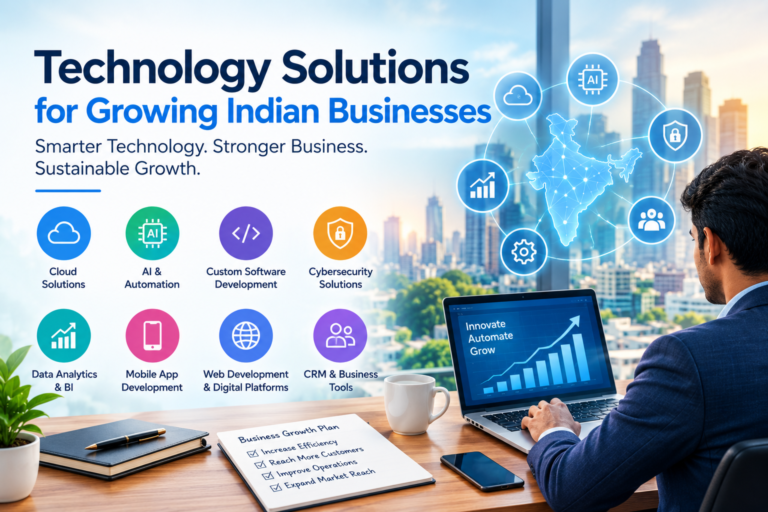
India’s growing digital ecosystem has created new opportunities for businesses across industries. Companies can now use cloud platforms, automation, data analytics, artificial intelligence, and digital marketing to improve the way they operate.
Technology can help businesses:
- Automate repetitive tasks and reduce manual work.
- Improve communication between teams and departments.
- Manage customer information more efficiently.
- Strengthen cybersecurity and protect business data.
- Understand customer behaviour through analytics.
- Expand their reach through digital platforms.
- Make faster, data-driven business decisions.
However, technology delivers these benefits only when it is implemented strategically. According to Deloitte India’s technology priorities survey, cybersecurity, cloud computing, and AI and machine learning were among the leading digital adoption priorities for surveyed businesses. The findings highlight the importance of combining innovation with security, skills, and effective implementation.
1. Cybersecurity Threats and Data Privacy Risks
Cybersecurity is one of the most important technology challenges faced by Indian businesses. As organisations rely increasingly on digital payments, cloud applications, customer databases, and online communication, they also become exposed to cyber threats.
Common risks include phishing attacks, ransomware, weak passwords, unauthorised access, data leaks, and compromised business accounts.
For small and medium-sized enterprises, a security incident can disrupt operations, damage customer trust, and create unexpected financial costs.
How can businesses solve this challenge?
Businesses should develop a proactive cybersecurity strategy instead of responding only after an incident occurs.
Recommended measures include:
- Enable multi-factor authentication for important accounts.
- Use strong passwords and a secure password manager.
- Install security updates for operating systems and applications.
- Back up important business data regularly.
- Restrict access to sensitive information based on employee roles.
- Train employees to recognise suspicious emails and links.
- Establish a clear incident response and recovery plan.
Businesses handling personal or financial information should also assess their applicable legal and regulatory obligations.
Key takeaway: Cybersecurity should be a continuous business priority, not a one-time technical installation.
2. High Technology Implementation Costs
Many Indian businesses hesitate to adopt new technologies because of budget constraints. Purchasing software, upgrading hardware, hiring specialists, maintaining infrastructure, and training employees can require significant investment.
Another common problem is investing in tools that offer features a business does not actually need. This can increase costs without producing measurable improvements.
How can businesses solve this challenge?
The best approach is to invest according to business priorities.
Start by identifying operational bottlenecks and estimating how much time, money, or effort a suitable technology solution could save. Compare available tools based on their functionality, scalability, security, and total cost of ownership.
Businesses can also:
- Begin with a small pilot project before implementing a solution company-wide.
- Use suitable subscription-based software instead of expensive custom systems where practical.
- Prioritise tools that solve clearly defined business problems.
- Review software subscriptions regularly to eliminate unnecessary expenses.
- Measure results through productivity, operating costs, conversion rates, and customer satisfaction.
A phased implementation strategy allows businesses to manage financial risk while gradually improving their digital capabilities.
3. Shortage of Skilled Technology Professionals
Technology evolves rapidly, and businesses often struggle to find employees with the right technical knowledge. Skills related to cybersecurity, cloud computing, artificial intelligence, data analytics, and software development are particularly important for modern digital operations.
The challenge is not limited to hiring. Existing employees may also need support to adapt to new systems and workflows.
Without the right skills, businesses may underuse software, experience implementation delays, or become overly dependent on external service providers.
How can businesses solve this challenge?
Organisations should treat digital skill development as an ongoing investment.
Practical steps include:
- Assessing the technology skills required for current business objectives.
- Providing regular employee training and upskilling opportunities.
- Creating simple documentation and standard operating procedures.
- Encouraging collaboration between technical and non-technical teams.
- Working with qualified technology consultants when specialist expertise is needed.
- Training employees before introducing major changes to existing workflows.
An effective technology partner can also help businesses understand which skills they need internally and which activities can be supported externally.
4. Legacy Systems and Technology Integration Problems
Some businesses continue to depend on outdated software, spreadsheets, disconnected databases, or manual processes. Although these systems may have supported earlier growth, they can become difficult to maintain as operations expand.
Legacy systems may not communicate properly with modern applications. As a result, employees may need to enter the same information repeatedly, move data manually, or rely on multiple tools to complete a single task.
This can increase errors, slow down decision-making, and make business operations harder to scale.
How can businesses solve this challenge?
Businesses should evaluate their existing technology before investing in replacements.
The process can include:
- Audit existing systems: Identify outdated tools, duplicate processes, and recurring technical issues.
- Map business workflows: Understand how information moves between departments.
- Identify integration requirements: Determine which applications need to exchange information.
- Prioritise critical improvements: Fix the systems that create the greatest operational problems first.
- Test before deployment: Check data accuracy, security, and performance before introducing changes across the organisation.
Where appropriate, APIs, integration platforms, and modern cloud-based applications can help connect existing systems.
The goal is not to replace every old tool immediately. It is to create a reliable technology environment that supports business growth.
5. Difficulty Adopting Cloud Computing
Cloud computing allows businesses to access software, storage, computing resources, and collaboration tools over the internet. It can improve flexibility and make it easier to support remote teams and growing operations.
However, cloud adoption also introduces challenges. Businesses may face migration difficulties, unexpected costs, access-control issues, downtime risks, or confusion about where their data is stored.
Moving everything to the cloud without a clear plan can create unnecessary complexity.
How can businesses solve this challenge?
A structured cloud adoption strategy should begin with an assessment of business requirements.
Businesses should determine which applications and data are suitable for cloud migration, estimate the expected costs, and identify any compliance or security requirements.
Important steps include:
- Choosing cloud services that match operational needs.
- Planning data migration carefully.
- Setting appropriate user permissions and access controls.
- Monitoring usage and recurring cloud expenses.
- Maintaining backups and disaster recovery procedures.
- Reviewing service availability and security responsibilities.
Not every business needs the same cloud setup. Depending on its requirements, an organisation may benefit from public cloud, private cloud, hybrid cloud, or a combination of on-premises and cloud systems.
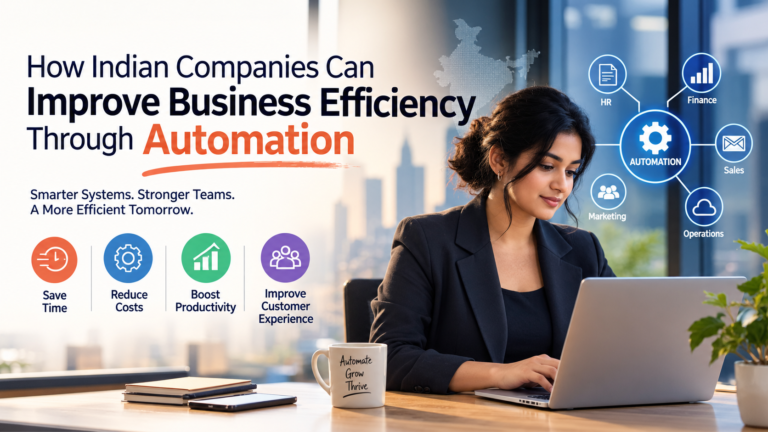
6. Inefficient Manual Processes and Limited Automation
Manual processes remain a major barrier to productivity in many businesses. Employees may spend considerable time preparing reports, updating records, tracking leads, managing appointments, processing routine requests, or transferring data between applications.
These repetitive activities can reduce the time available for customer service, sales, planning, and other high-value work.
How can businesses solve this challenge?
Automation can help reduce repetitive work and improve consistency.
Depending on the business, suitable solutions may include:
- CRM software for customer and lead management.
- Automated email and follow-up workflows.
- Inventory and order management systems.
- Digital invoicing and reporting tools.
- Workflow automation between connected applications.
- AI-assisted customer support and internal knowledge tools.
Businesses should begin with processes that are frequent, repetitive, and easy to measure. They should also retain human oversight for sensitive decisions, exceptions, and customer interactions that require judgement.
The objective of automation is to improve the way people work, not simply to introduce more software.
7. Poor Data Management and Limited Business Insights
Businesses generate data through sales, customer interactions, websites, marketing campaigns, inventory systems, and financial operations. However, having data does not automatically lead to better decisions.
Information may be stored in disconnected systems, contain errors, or be presented in formats that are difficult to interpret. Without reliable reporting, business leaders may struggle to identify customer trends, operational inefficiencies, and growth opportunities.
How can businesses solve this challenge?
Organisations should establish a consistent approach to collecting, managing, and analysing business data.
Useful steps include:
- Maintaining accurate and standardised records.
- Reducing duplicate customer and transaction entries.
- Connecting relevant data sources where appropriate.
- Creating dashboards for important business metrics.
- Reviewing reports regularly to identify trends.
- Assigning responsibility for data quality and access.
Businesses should select metrics that connect directly to their goals. For example, a sales team may monitor lead conversion and sales-cycle length, while an operations team may focus on order accuracy, turnaround time, and operating costs.
Reliable data helps organisations make informed decisions rather than relying entirely on assumptions.
8. Difficulty Integrating Artificial Intelligence into Business Operations
Artificial intelligence is creating new opportunities in customer support, content analysis, forecasting, document processing, and workflow automation. Nevertheless, adopting AI without a clear purpose can lead to disappointing results.
Businesses may struggle with data quality, implementation costs, employee readiness, privacy concerns, and uncertainty about which use cases are worth pursuing.
AI-generated outputs can also contain errors, so relying on them without appropriate review may create business and reputational risks.
How can businesses solve this challenge?
A practical AI adoption strategy should focus on specific business problems rather than following trends.
Businesses can begin by identifying tasks where AI could save time, improve analysis, or assist employees. They should then run a limited pilot, evaluate its performance, and expand the solution only when the results justify it.
A responsible AI implementation plan should include:
- Clear business objectives and success metrics.
- Appropriate data protection and access controls.
- Human review of important AI-generated outputs.
- Employee training and usage guidelines.
- Testing for accuracy, reliability, and bias where relevant.
- Regular performance and cost assessments.
For example, a business might test AI-assisted customer enquiry classification or internal document search before considering more complex applications.
AI is most useful when it complements reliable processes, relevant data, and human expertise.
9. Weak Digital Presence and Limited Online Customer Acquisition
Technology challenges are not restricted to internal operations. Many businesses also struggle to build a strong online presence and turn digital visibility into actual enquiries or sales.
A business may have a website but receive little relevant traffic. It may post regularly on social media without reaching the right audience, or generate website visitors without converting them into customers.
These problems can arise from poor website performance, weak search engine optimisation, unclear messaging, limited analytics, or an inconsistent digital strategy.
How can businesses solve this challenge?
Businesses should connect their digital platforms to clear customer acquisition goals.
An effective strategy may include:
- Developing a fast, mobile-friendly website.
- Optimising website pages for relevant search queries.
- Creating useful content that answers customer questions.
- Improving local SEO and maintaining accurate business information.
- Using appropriate analytics to understand visitor behaviour.
- Creating clear enquiry forms and calls to action.
- Tracking leads and conversions across marketing channels.
For businesses serving a specific geographic area, local search visibility can be particularly valuable. Optimising for relevant local searches helps potential customers discover products and services when they are actively looking for them.
Technology, SEO, and business development work best when they support the same commercial objectives.
10. Resistance to Digital Transformation
Even when a technology solution is useful, employees may hesitate to adopt it. They might be comfortable with existing processes, uncertain about the new system, or concerned that automation will make their work more complicated.
Poor communication and insufficient training can make this resistance worse. As a result, a business may invest in technology without achieving its expected benefits.
How can businesses solve this challenge?
Digital transformation requires organisational planning as well as technical implementation.
Business leaders should explain why the change is necessary, how it will improve workflows, and what support employees will receive.
A successful approach includes:
- Involving employees in the planning process.
- Demonstrating the practical benefits of new tools.
- Providing role-specific training.
- Introducing changes in manageable stages.
- Collecting feedback after implementation.
- Reviewing adoption rates and addressing difficulties quickly.
When employees understand the purpose of a technology initiative, they are more likely to use it effectively.
How to Choose the Right Technology Solutions for Your Business
Every business has different priorities. A startup may need affordable cloud software and customer relationship management, while a growing manufacturer may focus on inventory systems, operational automation, and data integration.
Before investing in a new solution, consider the following questions:
| Evaluation area | Questions to ask |
|---|---|
| Business goals | What specific problem are we trying to solve? |
| Budget | What are the initial and ongoing costs? |
| Scalability | Will the solution support future growth? |
| Integration | Can it work with our existing systems? |
| Security | How will business and customer data be protected? |
| Usability | Can employees learn and use it effectively? |
| Measurement | Which metrics will show whether it is working? |
A clear evaluation process helps businesses avoid unnecessary technology spending and prioritise investments that offer measurable value.
Why Work with an Indian Technology Company?
Partnering with an experienced Indian technology company can help businesses navigate technical complexity and make better-informed decisions.
Depending on its service offerings, a technology partner may support businesses with software development, system integration, cloud adoption, automation, data management, cybersecurity planning, or digital transformation.
The right partner should understand the organisation’s business objectives rather than recommending technology simply because it is new or popular.
Before choosing a provider, businesses should evaluate its relevant experience, technical capabilities, communication process, project approach, security practices, and post-implementation support.
It is also important to establish clear project milestones, deliverables, budgets, and success criteria before beginning a major implementation.
For small and medium-sized businesses, a practical and scalable solution may be more valuable than a complex system that is difficult to maintain.
How Business Development Supports Technology-Driven Growth
Technology can improve internal operations, but businesses also need a strategy for reaching customers, strengthening relationships, and generating revenue.
Business development helps connect operational improvements with commercial opportunities. This may involve identifying target markets, improving sales processes, building partnerships, strengthening customer relationships, and creating a more structured approach to growth.
When business development and technology work together, companies can manage leads more efficiently, understand customer needs, track sales performance, and make better use of digital channels.
For example, integrating a CRM system with a structured sales process can help teams follow up with prospects on time, maintain accurate customer records, and identify opportunities that might otherwise be missed.
This alignment ensures that technology investments contribute to measurable business outcomes rather than functioning as isolated technical projects.
Seoxcelerate: Supporting Business Growth Through Strategic Digital Solutions
Businesses looking to improve their digital capabilities need a clear understanding of their goals, customers, and operational challenges.
Seoxcelerate focuses on digital marketing and online growth, helping businesses strengthen their visibility and build a more structured digital presence. For organisations seeking better online reach, search engine optimisation, content strategy, and other suitable digital marketing activities can support customer discovery and lead generation.
When evaluating a digital or technology partner, businesses should identify their immediate priorities, such as improving search visibility, generating qualified enquiries, upgrading their digital presence, or creating a more measurable marketing process.
The right strategy should be practical, aligned with available resources, and measured against meaningful business goals.
If you are looking for the best business development company in Konnagar, compare providers based on their understanding of your market, service relevance, communication, measurable objectives, and ability to support your growth plans.
Seoxcelerate can be a starting point for businesses exploring digital marketing and online visibility solutions. Before selecting any provider, clarify the services you need and assess whether the proposed approach fits your business objectives.
Conclusion
Technology challenges can slow down business growth, increase operating costs, and make it harder to compete in an increasingly digital marketplace. Cybersecurity risks, skill shortages, legacy systems, manual processes, poor data management, and ineffective digital strategies all require careful attention.
The solution is not to adopt every new technology. It is to identify the problems that matter most, select appropriate tools, prepare employees, protect business data, and measure the results.
By combining a clear technology roadmap with effective business development and digital marketing, Indian businesses can improve efficiency, strengthen customer relationships, and create a stronger foundation for sustainable growth.
Whether you are a startup, an SME, or an established organisation, the right strategy and the right partners can help turn technology challenges into opportunities.
Frequently Asked Questions (FAQs)
1. What are the biggest technology challenges faced by Indian businesses?
Common challenges include cybersecurity threats, high implementation costs, shortage of skilled professionals, legacy systems, cloud migration, manual processes, poor data management, AI adoption, and resistance to digital transformation.
2. How can small businesses in India overcome technology challenges?
Small businesses can begin by identifying their most urgent operational problems, adopting affordable and scalable software, improving cybersecurity, training employees, and implementing technology in phases. Measuring results helps ensure that investments deliver practical value.
3. Why is cybersecurity important for Indian businesses?
Cybersecurity helps protect customer information, financial records, business systems, and operational continuity. Strong security practices can reduce the risk of unauthorised access, data breaches, fraud, and costly disruptions.
4. How can an Indian technology company help a growing business?
Depending on its specialisation, an Indian technology company can help a business implement software, integrate systems, adopt cloud services, automate workflows, improve data management, or plan digital transformation. Businesses should choose a provider based on their specific requirements and verified capabilities.
5. How can AI improve business operations?
AI can assist with repetitive tasks, document processing, customer enquiry classification, data analysis, forecasting, and internal knowledge retrieval. Businesses should begin with well-defined use cases and maintain appropriate human oversight.
6. Why is digital transformation important for SMEs?
Digital transformation can help small and medium-sized enterprises improve productivity, organise customer information, reduce manual work, and respond more effectively to changing customer expectations. A phased approach can make transformation more manageable.
7. How do I choose the best business development company in Konnagar?
Evaluate a provider’s understanding of your industry and local market, relevant services, communication, transparency, project approach, and ability to define measurable outcomes. Select a company whose services align with your specific growth requirements.
8. Can digital marketing help businesses overcome technology-related growth challenges?
Digital marketing can help businesses improve online visibility, attract relevant audiences, generate enquiries, and measure customer acquisition. SEO, content marketing, analytics, and local SEO can be particularly useful when integrated into a broader business growth strategy.