How Indian SMEs Can Use Technology to Compete With Larger Businesses
Small and medium-sized enterprises (SMEs) are an important part of India’s technology business ecosystem. As competition becomes increasingly digital, businesses no longer have to rely solely on size, physical presence, or large marketing budgets to compete.
Technology is changing that equation.
With the right combination of cloud computing, artificial intelligence, automation, digital marketing, data analytics, cybersecurity, and custom software, an SME can improve efficiency, reach customers across markets, and deliver better experiences without necessarily investing like a large enterprise.
This is where our Indian technology company can become an important strategic partner for growing businesses.
Rather than viewing technology as simply an IT expense, SMEs can use it as a tool for improving productivity, reducing repetitive work, understanding customers, and creating new opportunities for growth.
Why Technology Matters for Indian SMEs
India’s MSME sector represents a significant part of the country’s economy. According to the Ministry of Micro, Small and Medium Enterprises’ 2025–26 annual report, the sector contributes around 31.1% of India’s GDP and more than 48.5% of exports. The Ministry also identifies technology adoption and digitalization among the areas important to strengthening the MSME ecosystem.
At the same time, the number of registered MSMEs continues to grow. The Ministry’s MSME dashboard reported more than 9.74 crore MSMEs and informal micro enterprises registered through Udyam and Udyam Assist Platform as of October 3, 2026.
For such a large and diverse business community, technology can provide a way to compete based on speed, customer experience, efficiency, and innovation rather than simply scale.
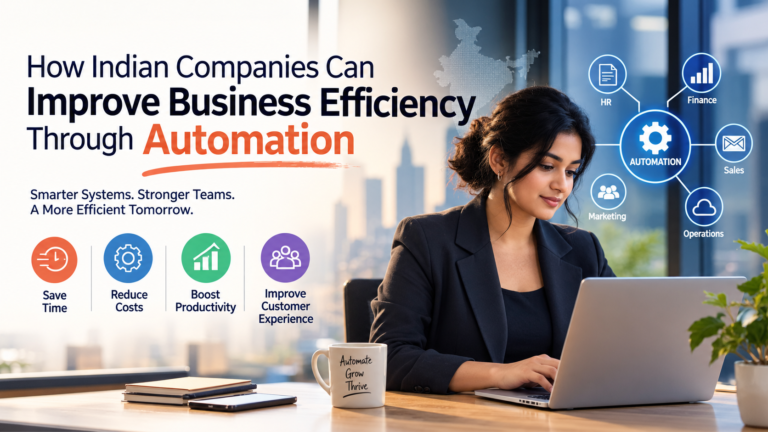
1. Automate Repetitive Business Processes
Large companies often have dedicated teams handling administrative and operational tasks. An SME may not have the same resources.
Automation can help bridge that gap.
Businesses can automate processes such as:
- Lead management
- Customer follow-ups
- Invoice generation
- Appointment scheduling
- Email communication
- Inventory updates
- Employee workflows
- Data entry
- Customer support
- Reporting
For example, instead of manually entering customer information into multiple systems, an integrated software solution can automatically transfer the information between platforms.
This saves employee time and reduces the possibility of human error.
An Indian technology company can help SMEs identify repetitive processes and implement appropriate automation solutions without unnecessarily complicating their existing operations.
2. Use Cloud Technology to Reduce Infrastructure Barriers
Traditionally, businesses had to invest significantly in servers, hardware, storage, and IT infrastructure.
Cloud technology has changed this model.
With cloud-based applications, SMEs can access computing resources and business software without maintaining extensive physical infrastructure themselves.
Cloud solutions can help businesses with:
- Data storage
- Remote collaboration
- Business applications
- Backup and recovery
- Scalable computing
- Document management
- Customer relationship management
- Business analytics
This can allow a growing company to scale its technology infrastructure as its business requirements change.
The key is choosing cloud solutions based on actual business needs rather than adopting technology simply because it is popular.
3. Use AI to Improve Business Productivity
Artificial intelligence is increasingly becoming accessible to smaller businesses.
India’s IndiaAI initiative has specifically identified startups and MSMEs among the groups that can access AI computing resources through its ecosystem. The IndiaAI Compute portal aims to make AI compute, network, storage, and platform services available at more affordable rates.
For SMEs, AI doesn’t necessarily mean building a sophisticated AI model from scratch.
Practical applications can include:
- AI-powered customer support
- Document processing
- Sales assistance
- Content generation
- Data analysis
- Demand forecasting
- Lead qualification
- Workflow automation
- Internal knowledge assistants
The objective should be simple: use AI where it solves a real business problem.
An experienced technology partner can help an SME identify suitable AI use cases while considering cost, security, integration, and scalability.
4. Reach Customers Beyond Your Local Market
One of the biggest advantages technology offers SMEs is the ability to reach customers beyond their immediate geographic area.
A small business can use:
- Search engine optimization
- Social media
- E-commerce platforms
- Digital advertising
- Email marketing
- Content marketing
- Online marketplaces
- Customer relationship management tools
to reach customers across India and potentially international markets.
For example, a specialized manufacturer based in a smaller Indian city can use a well-optimized website and digital marketing strategy to generate enquiries from customers in other states or countries.
Technology effectively reduces the limitations imposed by physical location.
5. Build a Stronger Customer Experience
Large businesses often have sophisticated systems for tracking customer interactions.
SMEs can adopt similar approaches at an appropriate scale.
A Customer Relationship Management (CRM) system can help businesses organize:
- Customer information
- Leads
- Sales activities
- Follow-ups
- Communication history
- Customer support requests
- Sales pipelines
Instead of relying on spreadsheets or scattered conversations, employees can access relevant customer information from a centralized system.
This can lead to faster responses and more consistent customer communication.
For an SME, a better customer experience can become an important competitive advantage.
6. Make Decisions Using Business Data
Data is valuable only when businesses can turn it into useful information.
Modern analytics tools can help SMEs understand:
- Which products generate the most revenue
- Where customers are coming from
- Which marketing campaigns perform well
- Which sales channels generate leads
- Where operational costs are increasing
- Which customers are most valuable
- Where bottlenecks occur
Instead of making decisions based entirely on assumptions, business owners can use actual performance data.
An Indian technology company can help SMEs connect different data sources and create dashboards that make important business information easier to understand.
7. Adopt Custom Software When Standard Tools Are Not Enough
Off-the-shelf software can work well for many businesses, but it isn’t always the perfect fit.
An SME may have a unique workflow that standard software cannot accommodate efficiently.
Custom software development can help businesses create solutions around their specific processes.
Examples include:
- Custom CRM platforms
- Inventory management systems
- Business dashboards
- Customer portals
- Booking platforms
- Workflow management software
- E-commerce applications
- Industry-specific platforms
However, custom software should not be developed simply because it is possible.
Before investing in a custom solution, businesses should evaluate whether the expected operational or financial benefit justifies the development and maintenance cost.
8. Improve Cybersecurity as the Business Grows
As businesses become more digital, cybersecurity becomes increasingly important.
SMEs can hold valuable information including:
- Customer data
- Financial information
- Business documents
- Employee information
- Login credentials
- Intellectual property
Basic cybersecurity measures can include:
- Multi-factor authentication
- Secure passwords
- Regular software updates
- Employee security training
- Data backups
- Access controls
- Endpoint protection
- Network security
- Security monitoring
Cybersecurity should be treated as part of the technology strategy rather than an afterthought.
9. Integrate Different Business Systems
Many SMEs use multiple digital tools.
For example, a business may use separate systems for:
Website → CRM → Accounting → Inventory → Customer Support
If these systems don’t communicate with each other, employees may have to repeatedly enter the same information.
Technology integration can connect these systems and create smoother workflows.
APIs and software integrations can help synchronize information between applications, reducing repetitive work and improving data consistency.
This is another area where an Indian technology company can help businesses identify integration opportunities and build solutions around their existing technology stack.
10. Scale Without Increasing Complexity
One of the biggest benefits of technology is scalability.
A well-designed digital system can allow a business to handle increasing customers, transactions, and data without increasing manual work at the same rate.
For example:
Manual process:
100 customers → 5 employees → extensive manual work
Automated process:
100 customers → automated workflows → employees focus on higher-value activities
As the business grows, technology can help maintain operational efficiency.
However, scalability should be planned from the beginning. Businesses should consider future users, data volumes, integrations, security requirements, and maintenance before implementing major systems.
How Can an Indian Technology Company Help SMEs?
Choosing technology is often more complicated than simply purchasing software.
A technology partner can help an SME move through several stages:
1. Identify the Problem
First, understand what is slowing the business down.
2. Evaluate Existing Technology
Review the current software, infrastructure, workflows, and data.
3. Identify Technology Opportunities
Determine where automation, AI, cloud, software development, or integration could provide value.
4. Select the Right Solution
Choose technology based on business requirements, budget, scalability, and expected outcomes.
5. Implement the Solution
Deploy the technology while minimizing disruption to existing operations.
6. Train Employees
Technology delivers value only when employees can use it effectively.
7. Monitor and Improve
Regularly evaluate performance and make improvements as business requirements evolve.
This approach allows SMEs to treat technology as a business growth tool rather than simply an IT purchase.
Technology Does Not Have to Mean High Costs
One common misconception among small businesses is that advanced technology is only affordable for large corporations.
That isn’t necessarily the case.
SMEs can begin with smaller, focused improvements.
For example:
Stage 1: Move documents and workflows to the cloud.
Stage 2: Introduce CRM and automated customer follow-ups.
Stage 3: Integrate business applications.
Stage 4: Introduce analytics and reporting.
Stage 5: Explore AI and advanced automation.
This gradual approach allows businesses to prioritize investments according to their actual requirements.
The right technology strategy is not necessarily the one with the most features. It is the one that solves the right problems.
How SMEs Can Compete With Larger Businesses Using Technology
Technology can help SMEs compete in several important areas.
| Business Challenge | Technology Opportunity |
|---|---|
| Limited workforce | Automation |
| Limited geographic reach | Digital platforms |
| Manual processes | Workflow automation |
| Slow customer response | CRM and AI assistants |
| High infrastructure costs | Cloud computing |
| Poor visibility into performance | Data analytics |
| Complex operations | Custom software |
| Growing cybersecurity risks | Security solutions |
| Disconnected systems | API integrations |
| Increasing customer expectations | Digital customer experiences |
The goal isn’t to replicate everything a large company does.
Instead, SMEs should identify where technology can create a specific competitive advantage.
Choosing the Right Technology Partner in India
The technology partner an SME chooses can have a significant impact on the success of a digital transformation project.
Before working with an Indian technology company, businesses should consider:
- Does the company understand your industry?
- Can it understand your business problem before proposing a solution?
- Does it provide scalable technology?
- Can it integrate with your existing systems?
- Does it provide ongoing technical support?
- Does it understand cybersecurity requirements?
- Can it explain technical concepts clearly?
- Does it have relevant project experience?
- Is the proposed solution aligned with your budget and objectives?
The right technology partner should focus on business outcomes, not simply technology implementation.
The Future of Technology for Indian SMEs
Technology adoption among Indian businesses is likely to continue evolving as AI, cloud computing, automation, analytics, and digital platforms become more accessible.
India’s national AI initiatives also demonstrate the growing focus on making AI infrastructure and resources accessible to startups and MSMEs.
For SMEs, the opportunity is not about adopting every new technology.
It is about identifying the technologies that can make the business:
- Faster
- More efficient
- More customer-focused
- More data-driven
- More scalable
- More secure
Businesses that approach technology strategically can create capabilities that were previously associated mainly with larger organizations.
Conclusion
Indian SMEs don’t necessarily need the resources of a large corporation to compete effectively. With the right technology strategy, they can use automation, cloud computing, AI, analytics, custom software, digital marketing, cybersecurity, and system integration to improve how they operate and serve customers.
An Indian technology company can play an important role in this journey by helping SMEs identify business challenges, select appropriate technology, implement scalable solutions, and continuously improve their digital infrastructure.
The objective isn’t simply to become more technologically advanced.
It is to use technology to work smarter, serve customers better, make informed decisions, and create sustainable business growth.
For Indian SMEs, technology is no longer just a support function. It can be a strategic tool for competing in an increasingly digital marketplace.