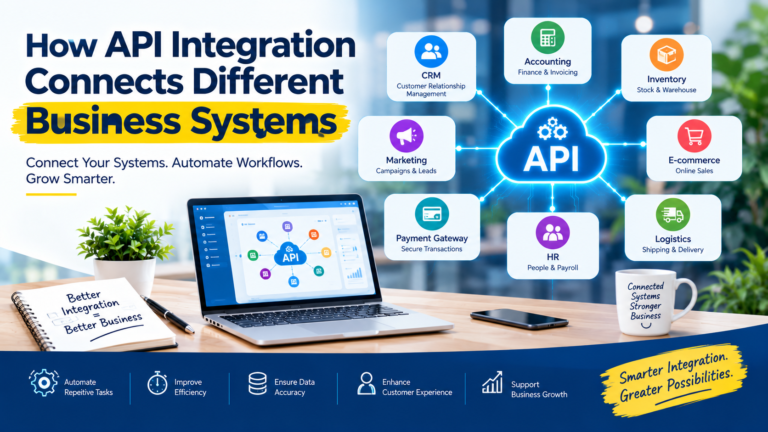
How Payment Gateway API Integration Improves Online Business Operations
Introduction
The rapid growth of digital commerce has transformed how businesses operate, interact with customers, and manage financial transactions. Today, customers expect online businesses to provide convenient, fast, and secure payment options. Whether purchasing products from an e-commerce website, subscribing to an online service, or booking an appointment, customers prefer seamless digital payment experiences.
This growing demand has made Payment Gateway API Integration an essential part of modern business technology.
A payment gateway API allows websites, mobile applications, and business platforms to connect with payment processing services. It enables businesses to accept digital payments, automate transaction management, verify payment statuses, and improve overall operational efficiency.
For businesses operating in India’s competitive digital economy, adopting the right technology solutions is important for long-term growth.
A forward-thinking Indian technology company understands that digital transformation involves more than developing websites and applications. It also involves building integrated systems that simplify business operations and improve customer experiences.
Similarly, businesses searching for the best business development company in Konnagar should recognize the importance of combining technology, automation, and strategic business development.
In this article, we will explore how payment gateway API integration improves online business operations and why it is becoming an important investment for modern organizations.
What Is Payment Gateway API Integration?
Payment Gateway API Integration is the process of connecting a business website, mobile application, or digital platform with a payment gateway through an Application Programming Interface (API).
An API enables two different software systems to communicate with each other.
When a customer purchases a product or service online, the payment gateway facilitates the transaction between the merchant, customer, payment processor, and relevant financial institutions.
For example, when a customer purchases a product from an online store and selects UPI as the payment method, the integrated payment gateway securely processes the payment and communicates the transaction status to the business platform.
This allows businesses to manage online payments without manually handling every transaction.
How Does Payment Gateway API Integration Work?
A typical payment gateway integration follows these steps:
- Customer Checkout: A customer selects a product or service and proceeds to checkout.
- Payment Method Selection: The customer chooses UPI, debit card, credit card, net banking, or another supported payment method.
- API Communication: The website sends a payment request to the payment gateway.
- Secure Transaction Processing: The payment gateway facilitates the transaction through the relevant payment network and financial institutions.
- Payment Verification: The merchant’s system verifies the transaction status using secure server-side mechanisms.
- Order Confirmation: Once payment is successfully confirmed, the website updates the order status and generates a confirmation message.
This automated process reduces manual work and makes digital transactions easier to manage.
1. Faster and More Efficient Payment Processing
Speed is an important factor in online business operations.
Customers expect transactions to be completed quickly without unnecessary delays. Complicated payment processes can create frustration and increase the possibility of abandoned purchases.
Payment gateway API integration helps businesses simplify their payment workflows.
It allows businesses to:
- Process digital payment requests efficiently.
- Receive automated transaction updates.
- Reduce manual payment verification.
- Generate instant payment confirmations where supported.
- Improve the overall checkout experience.
For e-commerce businesses, faster and more convenient payment processing can support better customer satisfaction and conversion opportunities.
An experienced Indian technology company can help businesses build digital platforms that integrate payment processing with their existing operational systems.
2. Multiple Digital Payment Options
Customers have different payment preferences. Some prefer UPI, while others use debit cards, credit cards, net banking, or digital wallets.
A payment gateway API allows businesses to provide multiple supported payment methods through a unified checkout system.
Popular digital payment options in India include:
- UPI payments.
- Credit and debit cards.
- Net banking.
- Supported digital wallets.
- EMI payment options, where available.
- Other provider-supported payment methods.
Offering multiple payment methods makes the purchasing process more convenient.
For businesses targeting customers across different regions of India, payment flexibility can improve accessibility and create a better digital shopping experience.
3. Improved Online Payment Security
Security is one of the most important aspects of digital transactions.
Customers need assurance that their payment information is protected when making purchases online.
Modern payment gateways provide various security features to protect transaction data and reduce fraudulent activities.
These may include:
- SSL/TLS-encrypted communication.
- Payment tokenization.
- Secure authentication.
- Fraud detection systems.
- Risk-based transaction monitoring.
- PCI DSS-aligned payment environments.
- Support for applicable regulatory requirements.
Businesses should work with trusted payment providers and follow recommended security practices during integration.
They should also protect API credentials, verify payment notifications, and avoid storing sensitive payment information unnecessarily.
A secure payment infrastructure builds customer confidence and supports reliable online business operations.
4. Automation of Business Operations
Manual payment management can become challenging as transaction volumes increase.
Businesses often need to verify payments, update orders, generate receipts, manage refunds, and maintain transaction records.
Payment gateway API integration helps automate many of these repetitive activities.
For example:
- Successful transactions can automatically update order records.
- Payment confirmations can be sent to customers.
- Failed payments can trigger notifications.
- Refund requests can be processed through supported APIs.
- Transaction data can be synchronized with other business systems.
Automation reduces administrative workload and allows employees to concentrate on important business activities.
Technology-driven automation is one of the key areas where an Indian technology company can help organizations improve productivity and operational efficiency.
5. Better Customer Experience and Checkout Optimization
Customer experience directly influences online business performance.
A complicated checkout process can discourage customers from completing purchases.
Payment gateway API integration makes it possible to create a more streamlined checkout experience.
Important features include:
- Mobile-friendly payment interfaces.
- Multiple payment options.
- Clear transaction instructions.
- Secure payment authentication.
- Automated payment confirmations.
- Convenient payment retries.
- Responsive checkout pages.
Businesses should also ensure that payment pages work smoothly across smartphones, tablets, and desktop devices.
A well-designed checkout experience reduces unnecessary friction and encourages customers to complete their purchases.
6. Real-Time Transaction Tracking
Businesses need accurate transaction information to manage their financial activities.
Payment gateway APIs provide access to transaction details that help organizations monitor payment operations.
Depending on the payment provider, businesses can track:
- Transaction IDs.
- Payment amounts.
- Payment methods.
- Transaction timestamps.
- Successful and failed payments.
- Refund status.
- Settlement information.
Webhooks can also notify business applications when specific payment events occur.
For example, when a payment is successfully completed, the payment provider can send an event notification to the merchant’s application.
The application should verify the notification and transaction status before updating the order.
This improves transaction visibility and helps businesses maintain accurate operational records.
7. Simplified Refund and Cancellation Management
Refunds are an important part of online business operations.
Customers may request refunds because of cancelled orders, product returns, duplicate payments, or service-related issues.
Managing refunds manually can be time-consuming, particularly for businesses handling a large number of transactions.
Payment gateway APIs may offer refund functionality that allows businesses to initiate and track refunds through their own applications.
Key benefits include:
- Simplified refund initiation.
- Reduced manual processing.
- Better refund status tracking.
- Improved customer communication.
- Easier transaction reconciliation.
Refund processing times depend on the payment provider, banking system, payment method, and applicable policies.
Automating supported refund operations helps businesses manage customer requests more efficiently.
8. Seamless Integration with E-commerce Platforms
Modern businesses use multiple digital systems to manage their daily operations.
Payment gateway APIs can connect payment processing with different business applications.
These include:
- E-commerce websites.
- Mobile applications.
- Customer Relationship Management (CRM) systems.
- Enterprise Resource Planning (ERP) platforms.
- Inventory management software.
- Accounting systems.
- Subscription management applications.
For example, when a customer completes an online purchase, the payment system can communicate with the order management platform and trigger inventory-related updates.
This creates a connected business ecosystem and reduces the need for repetitive manual activities.
A capable Indian technology company can help businesses identify the right integration architecture according to their operational requirements.
9. Improved Subscription and Recurring Payment Management
Subscription-based businesses depend on regular payments from customers.
Examples include:
- Software-as-a-Service (SaaS) platforms.
- Online education websites.
- Membership platforms.
- Digital service providers.
- Subscription-based product businesses.
Some payment gateway providers offer recurring payment API features that help businesses manage subscription billing.
These features may support:
- Recurring payment schedules.
- Subscription renewals.
- Payment notifications.
- Failed payment alerts.
- Mandate management.
- Subscription cancellation workflows.
In India, recurring payments must comply with applicable RBI requirements and relevant authorization processes.
Automated recurring payment management helps subscription-based businesses reduce administrative work and maintain more organized billing operations.
10. Reduced Payment Errors and Improved Accuracy
Manual transaction management can create errors in payment records and order processing.
For example, businesses may accidentally record duplicate transactions, overlook payment updates, or incorrectly mark an order as paid.
Payment gateway API integration helps minimize these risks through automated transaction communication.
Businesses can improve accuracy by implementing:
- Unique transaction identifiers.
- Secure payment verification.
- Webhook signature validation.
- Idempotency mechanisms.
- Automated order status updates.
- Transaction reconciliation.
- Proper error-handling systems.
Idempotency is particularly useful when payment requests are retried. It helps prevent duplicate operations when the same request is submitted more than once.
These practices make payment management more reliable.
11. Better Financial Reporting and Business Insights
Payment data can provide valuable information about business performance.
When payment gateway systems are connected with analytics and reporting platforms, businesses can monitor important financial indicators.
Useful metrics include:
- Total transaction value.
- Successful payment percentage.
- Failed transaction percentage.
- Average order value.
- Refund volume.
- Customer payment preferences.
- Settlement records.
These insights help business owners identify operational problems and make informed decisions.
For example, if a particular payment method experiences frequent transaction failures, businesses can investigate the issue and work with their payment provider to improve the payment experience.
Data-driven financial management supports better planning and business development.
12. Scalability for Growing Businesses
As businesses expand, their payment processing requirements also increase.
A small online business may initially handle a limited number of transactions. However, as customer demand grows, it needs a payment system capable of managing higher transaction volumes.
Payment gateway API integration helps businesses connect with payment infrastructure designed to support their operational requirements.
Businesses can also expand their payment systems with features such as:
- Additional payment methods.
- Subscription billing.
- Payment links.
- Multiple platform integration.
- Automated refunds.
- Advanced reporting.
- International payment acceptance, where available.
Choosing the right provider and implementing a scalable integration architecture helps businesses prepare for future growth.
13. Advanced Fraud Detection and Risk Management
Online businesses may face suspicious transactions, unauthorized payment attempts, and other payment-related risks.
Modern payment gateways often provide fraud detection and risk management features.
These may include:
- Suspicious transaction monitoring.
- Risk-based authentication.
- Transaction velocity checks.
- Device-related risk signals.
- Automated transaction screening.
- Fraud alerts.
Businesses should understand the risk management features offered by their payment provider and configure them according to their business model.
Combining secure payment integration with proper monitoring can help reduce financial risks.
14. Support for International Business Expansion
Businesses planning to reach international customers may need payment systems that support cross-border transactions.
Some payment gateway providers offer international payment acceptance and multi-currency capabilities.
Depending on provider availability and business eligibility, these features may include:
- International card payments.
- Multiple currency support.
- Cross-border payment processing.
- Currency conversion.
- International transaction reporting.
Before selecting an international payment solution, businesses should evaluate transaction fees, currency conversion charges, settlement policies, and regulatory requirements.
The right digital payment infrastructure can help businesses manage international transactions more efficiently.
15. Better Integration Between Marketing, Sales, and Technology
Payment gateway integration can also improve coordination between marketing, sales, and business management systems.
When payment information is connected with CRM and analytics platforms, businesses can gain a better understanding of customer behaviour.
For example, businesses can:
- Track purchases generated through marketing campaigns.
- Measure completed transactions.
- Identify popular products and services.
- Understand customer purchasing patterns.
- Evaluate campaign-related revenue.
- Develop customer retention strategies.
This creates opportunities for data-driven business decisions.
For a growing organization, combining website development, digital marketing, payment processing, and analytics can create a more effective digital ecosystem.
Key Factors to Consider Before Choosing a Payment Gateway API
Selecting the right payment gateway is an important technology decision.
Businesses should evaluate several factors before integrating a payment solution.
| Factor | What Businesses Should Evaluate |
|---|---|
| Security | Encryption, authentication, tokenization, and compliance |
| API Documentation | Integration guidelines and developer resources |
| Payment Options | UPI, cards, net banking, and supported wallets |
| Transaction Charges | Setup fees and payment processing costs |
| Settlement | Settlement schedules and reconciliation |
| Refund Management | Refund API availability and processing policies |
| Scalability | Ability to support increasing transaction volumes |
| Technical Support | Developer assistance and issue resolution |
| Reliability | Uptime, monitoring, and transaction recovery |
The right payment gateway should match your business model, customer requirements, technical infrastructure, and budget.
Common Challenges in Payment Gateway API Integration
Although payment gateway integration offers many advantages, businesses may encounter certain technical challenges.
1. Technical Integration Complexity
Payment API integration requires knowledge of API documentation, authentication, server-side development, and transaction workflows.
Solution: Work with experienced developers and follow the official integration documentation provided by the payment gateway.
2. Payment Failures
Transactions may fail because of network issues, authentication problems, insufficient funds, or payment provider errors.
Solution: Implement appropriate error handling, clear customer notifications, and secure retry mechanisms.
3. Security and Compliance
Payment systems must follow relevant security standards and applicable regulatory requirements.
Solution: Use trusted payment providers, secure API credentials, tokenization, and appropriate security practices.
4. Webhook Management
Payment notifications may be delayed, duplicated, or delivered out of order.
Solution: Validate webhook signatures, handle duplicate events, and verify transaction status before updating records.
5. Transaction Reconciliation
Businesses may find it difficult to match customer orders with payment transactions, refunds, and settlements.
Solution: Maintain unique transaction references and implement automated reconciliation processes.
Proper planning and technical implementation help businesses overcome these challenges.
Why Payment Gateway API Integration Matters for Indian Businesses
India’s digital economy has created significant opportunities for businesses to expand their online operations.
Customers increasingly expect convenient digital payment options, particularly UPI, cards, and net banking.
Payment gateway API integration helps Indian businesses:
- Accept multiple digital payment methods.
- Improve online checkout experiences.
- Automate payment confirmation.
- Simplify refund management.
- Connect financial data with business applications.
- Improve transaction monitoring.
- Support e-commerce expansion.
Businesses should select payment providers that comply with applicable Indian regulatory requirements and support their specific business activities.
As digital commerce continues to evolve, investing in reliable payment infrastructure can help organizations become more competitive.
How an Indian Technology Company Supports Digital Business Transformation
Technology is becoming a major driver of business development in India.
Companies across industries are investing in website development, software solutions, automation, API integration, and digital transformation to improve their operational efficiency.
An experienced Indian technology company understands that successful digital transformation requires a combination of technical expertise and business understanding.
Important technology services that support online business growth include:
1. Website Development: Creating professional, responsive, and user-friendly business websites.
2. Custom Software Development: Building applications according to specific business requirements.
3. API Integration: Connecting different software platforms to improve communication and automation.
4. Business Automation: Reducing repetitive tasks through technology-driven workflows.
5. E-commerce Development: Developing online platforms with product management, payment integration, and customer-friendly checkout systems.
6. Digital Marketing: Improving brand visibility through SEO, content marketing, and online promotional strategies.
By combining these services, businesses can establish a stronger digital foundation.
Why Choose the Best Business Development Company in Konnagar?
Business development involves identifying opportunities, building strategic relationships, improving market reach, and creating sustainable growth strategies.
In today’s competitive environment, technology and digital marketing play an important role in business development.
When searching for the best business development company in Konnagar, businesses should evaluate the company’s understanding of technology, marketing, customer acquisition, and long-term growth planning.
A reliable business development partner should focus on:
- Understanding business objectives.
- Identifying growth opportunities.
- Improving digital visibility.
- Developing effective marketing strategies.
- Strengthening brand positioning.
- Supporting customer acquisition.
- Encouraging technology adoption.
The combination of business development and technology-driven solutions can help organizations improve their market presence and operational capabilities.
The Future of Payment Gateway API Integration
The future of digital payments will continue to evolve with advancements in financial technology, automation, artificial intelligence, and API-driven applications.
Several developments are influencing the future of payment infrastructure.
AI-Based Fraud Detection
Artificial intelligence can help identify unusual transaction patterns and support more advanced fraud monitoring.
Faster Digital Payments
Businesses will continue adopting payment systems that offer convenient and efficient transaction experiences.
Unified Commerce Platforms
Integration between websites, applications, inventory systems, and payment platforms will create more connected business operations.
Improved Payment Automation
Automated payment verification, reconciliation, and refund workflows will become increasingly important.
Better Customer Personalization
Businesses can use transaction insights to understand customer preferences and improve their digital experiences.
Organizations that adopt suitable technologies will be better prepared to respond to changing customer expectations.
Conclusion
Payment Gateway API Integration has become an important part of modern online business operations.
It helps organizations process digital payments, automate repetitive activities, improve transaction security, manage refunds, track financial information, and connect different business applications.
Beyond payment processing, it contributes to better customer experiences, operational accuracy, and business scalability.
For Indian businesses looking to strengthen their digital infrastructure, investing in reliable payment integration and modern technology solutions can create valuable opportunities for growth.
A forward-thinking Indian technology company recognizes the importance of combining software development, API integration, automation, and digital business strategies.
Similarly, partnering with the best business development company in Konnagar can help businesses explore new opportunities and establish a stronger market presence.
Build smarter business operations with technology, embrace digital transformation, and create new opportunities for sustainable growth.
Frequently Asked Questions (FAQs)
1. What is Payment Gateway API Integration?
Payment Gateway API Integration is the process of connecting a business website or application with a payment gateway through an API. It allows businesses to accept and manage online transactions.
2. How does payment gateway integration improve business operations?
It automates payment processing, reduces manual work, supports multiple payment methods, simplifies refunds, improves transaction tracking, and creates a smoother customer experience.
3. Which payment methods can be integrated into an online business?
Depending on the payment provider, businesses can integrate UPI, debit cards, credit cards, net banking, digital wallets, and other supported payment methods.
4. Is payment gateway API integration secure?
It can be secure when implemented using trusted providers, encrypted communication, tokenization, secure authentication, and verified transaction notifications.
5. Can payment gateway APIs be integrated into e-commerce websites?
Yes. Payment gateway APIs can be integrated into e-commerce websites, mobile applications, booking platforms, and other digital business applications.
6. Can payment gateway integration automate refunds?
Many payment providers offer refund APIs that allow businesses to initiate and track refunds through their applications. The actual refund process depends on the provider and payment method.
7. Why do Indian businesses need payment gateway integration?
It helps Indian businesses accept digital payments, simplify online transactions, improve customer convenience, and automate payment-related business processes.
8. What should businesses consider before selecting a payment gateway?
Businesses should evaluate security, supported payment methods, API documentation, transaction charges, settlement timelines, refund features, scalability, and technical support.
9. What services does an Indian technology company provide?
An Indian technology company may provide website development, custom software development, mobile application development, API integration, automation, e-commerce solutions, and digital transformation services.
10. Which is the best business development company in Konnagar?
Businesses should evaluate business development companies based on their industry knowledge, strategic approach, technology understanding, marketing capabilities, and commitment to measurable business growth.